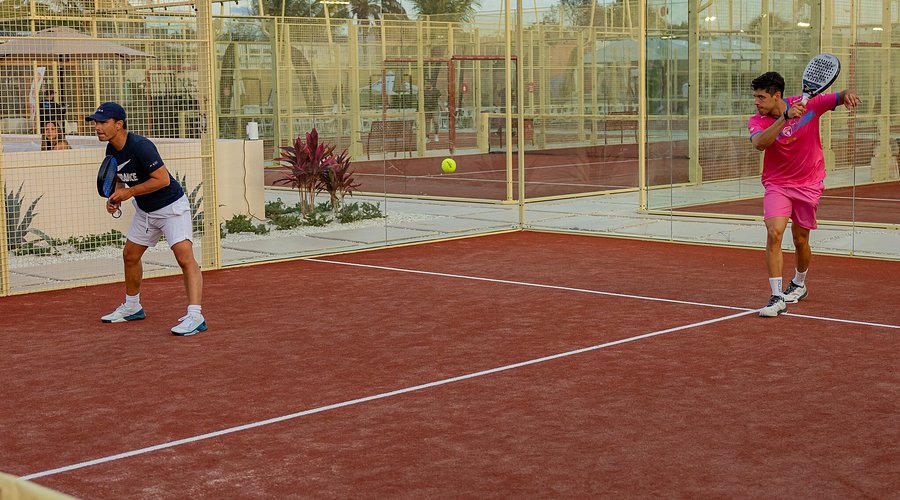
If you have been hearing more about padel lately, you are not imagining it. As of April 2026, padel has surpassed 1 million players in the United States, according to the Sports and Fitness Industry Association’s 2026 Topline Participation Report. The US now has over 1,000 courts nationwide, and investment in the sport is accelerating fast. A Pro Padel League recently raised $15 million to fuel US expansion.
Padel is no longer just a sport that people discover on vacation in Spain or Mexico. It is here, it is growing, and if you have not played yet, you are going to want to.
So What Exactly is Padel?
Padel is a racquet sport played in doubles on an enclosed glass court roughly a third the size of a tennis court. The court is surrounded by glass walls and metal mesh, and the ball can be played off the walls (similar to squash). Players use solid paddles with no strings, and the scoring follows tennis rules.
The best way to understand padel is to think of it as the best parts of tennis, pickleball, and squash combined into one sport. It is easier to pick up than tennis, equally fun for all ages like pickleball, and the addition of walls and a bouncier ball makes the points more dynamic and exciting than either.
As a former professional pickleball player who has competed at the highest level of racquet sports, I became completely addicted to padel the first time I played. The wall play adds a dimension that keeps you thinking constantly. Points that should be over keep going. It rewards creativity and teamwork in a way that is genuinely hard to find in other sports.
Where Did Padel Come From?
Padel was invented in Mexico in 1969 by Enrique Corcuera, who built the first court at his home in Acapulco. The sport spread through Latin America before taking root in Spain, where it became a mainstream phenomenon. Today Spain has over 20,000 padel courts and millions of active players. Argentina, Brazil, and Mexico all have deep padel cultures that predate the US market by decades.
That Latin American and European heritage is a big part of why padel is growing so fast in cities like Miami, Los Angeles, Houston, and New York, where large communities there already know and love the sport. Padel did not arrive in the US as something new. It arrived as something familiar to millions of people who had been waiting for it.
How is Padel Different From Tennis?
Padel and tennis share a scoring system and some basic mechanics, but the playing experience is very different.
The court is smaller and enclosed, which means the game can be both faster (since the ball is coming at you quickly) and slower (since the ball can bounce off the wall and come back to you). The walls are in play, which completely changes strategy. There are no overhead serves. The serve in padel is underhand, which makes it far more accessible to beginners. And because the court is smaller and doubles is the standard format, padel is inherently more social than tennis.
Tennis can feel like a sport that rewards years of technical training before it becomes truly fun. Padel rewards smart play and teamwork from the very first game.
How is Padel Different From Pickleball?
This is the question we get asked most often, especially from players who already love pickleball.
Both sports are played on smaller courts than tennis, both are doubles-focused, and both are far more accessible than tennis to beginners. But the differences matter. Padel courts are larger than pickleball courts and fully enclosed with glass. The ball is pressurized and bouncier. The wall play adds a different strategic layer than the kitchen in pickleball. As opposed to soft dink shots close to the net like pickleball, you will see more lobs and off-the-wall shots in padel.
Pickleball points tend to end at the kitchen line. Padel points keep going, bouncing off back walls and side glass, requiring repositioning and creativity that makes the game genuinely harder to master at the top level. For players who love pickleball but want more complexity and physical challenge, padel is the natural next step.
Padel also has a cultural richness from outside the US that pickleball is still building. Playing padel in America means playing alongside people who grew up with the sport in countries like Mexico, Argentina, or Spain. It is one of the most genuinely international sports communities in the US right now.
Why is Padel Growing So Fast in the US?
Several forces are converging at once.
The Latin American community in the US has been the early engine of growth, bringing a sport they already loved into new cities. But padel is now spreading well beyond that community. Investors are taking notice. The Pro Padel League raised $15 million in early 2026. Major fitness chains, hotel groups, and real estate developers are adding padel courts as premium amenities.
The sport also has a viral quality. It is genuinely fun from the first time you play, which means first-timers become regulars quickly. And because it is played in doubles in an enclosed court, it creates a social environment that keeps people coming back.
The US passed 1,000 courts in 2026. Europe has hundreds of thousands. By any measure, the US is still in the very early innings of what padel can become here.
The numbers tell the story clearly. As of 2026 the US has roughly 1,000 padel courts serving 1.1 million players. That means players are traveling significant distances just to find a court. For context, squash has been in the US since 1884 and has 530 plus courts after 140 years of infrastructure. Padel hit the same player count in 18 months. The comparison that puts it in sharpest relief: pickleball reached 1 million players around 2015, then exploded to 24 million over the next 10 years. Padel is at that same inflection point right now.
Where Can You Play Padel in the US?
Padel courts are opening across the country, with the highest concentration in Florida, Texas, California, and New York. You can find courts near you at PadelBrowser.com, which tracks US padel facilities nationwide.
If you want to play and there is no court near you yet, that is actually part of the opportunity. Padel is still early enough in the US that being the person who builds the first facility in your city is a real possibility. We have helped clients do exactly that in markets across the country.
Thinking About Building a Padel Facility?
We built US Padel Court Builders because when we got serious about padel, we realized there was no good US-based option for someone who wanted to build a facility from scratch. Every company we found was international, selling their own courts, and not equipped to handle the full project management that a US build requires.
We are the only US-based padel court company that manages the entire process from permits to opening day at no added cost to the build. If you are thinking about building a padel facility, we would love to talk.
Curious about costs? Read our complete guide: How Much Does a Padel Court Cost in the US?
Ready to build? Schedule a Free Consultation